Published - Thu, 11 Jun 2026
The Pillar of Heights: Why Professional Scaffolder and Inspector Training is Non-Negotiable

The Pillar of Heights: Why Professional Scaffolder and Inspector Training is Non-Negotiable

The Pillar of Heights: Why Professional Scaffolder and Inspector Training is Non-Negotiable - Key Insights & Details

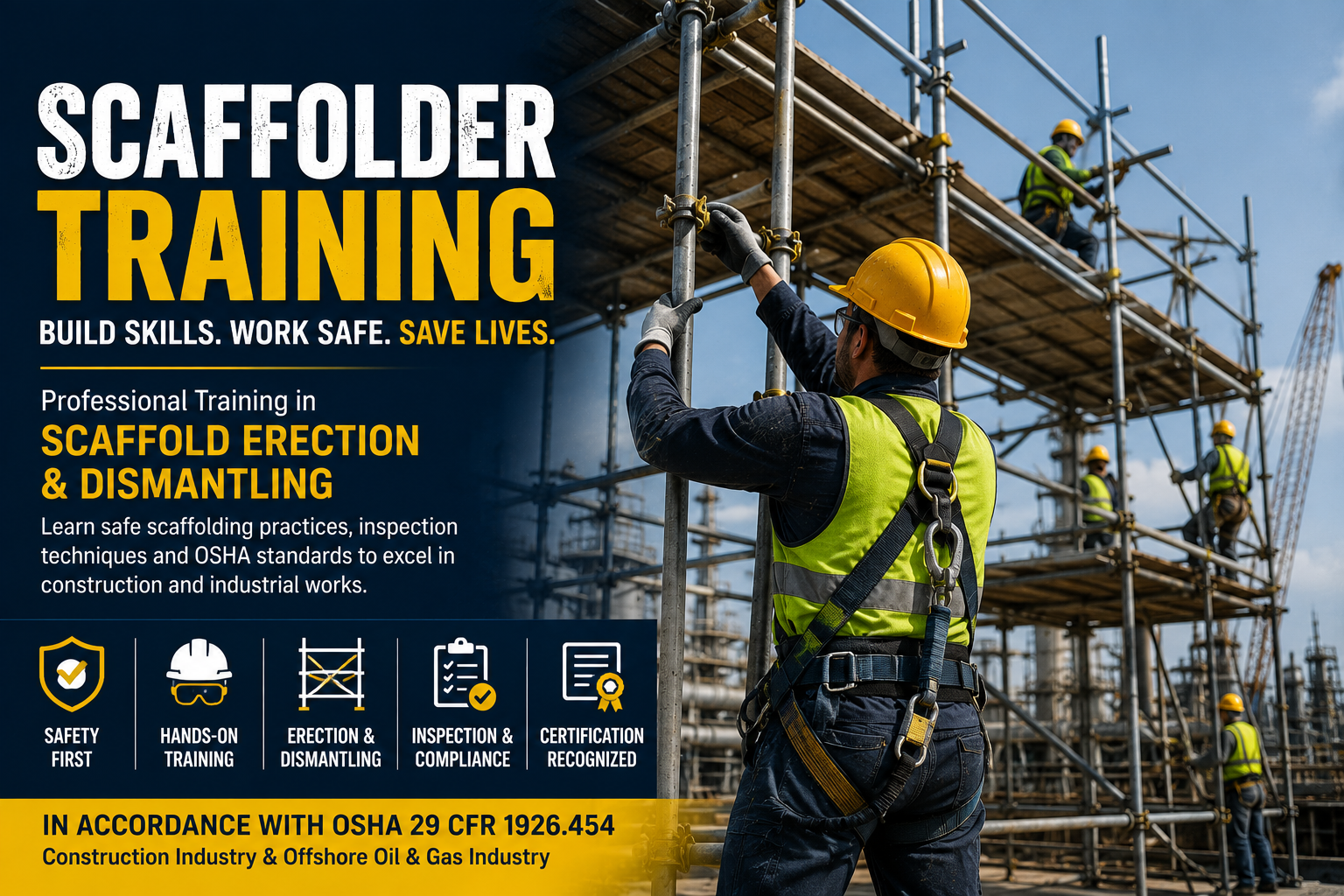
Scaffolding plays a critical role in construction, offshore operations, heavy industrial maintenance, and infrastructure projects. It provides personnel with safe access to elevated work areas while supporting the tools, equipment, and materials required to complete a project efficiently.

However, when scaffolds are erected, altered, or dismantled incorrectly, the consequences are invariably severe—leading to catastrophic falls, structural failures, and strict regulatory penalties.

This is why professional training isn't just a compliance checkbox; it is one of the most critical safety investments a company can make.


Understanding the Two Lines of Defense: Scaffolder vs. Inspector

A safe worksite requires two distinct types of trained professionals working in tandem:

  1. The Qualified Scaffolder: The individual trained in the physical mechanics, manual assembly, load calculation, and structural balancing required to build the asset safely.

  2. The Certified Scaffolding Inspector: The independent eye or "Competence Person" who systematically audits the structure against international standards, signs off on the safety tags, and identifies hidden defects before any worker steps onto the planks.


Common Scaffold Systems in Modern Worksites

Today’s industrial and offshore landscapes utilize highly specialized scaffolding systems engineered for specific load capacities and environments:

  • Tube and Clamp Scaffolds: Highly adaptable, making them the standard for complex geometry on offshore rigs and industrial refineries.

  • System / Modular Scaffolds (Frame): Prefabricated components that allow fast, rigid assembly on commercial construction sites.

  • Suspended Scaffolds: Platforms suspended by ropes or cables, commonly used in marine shipbuilding and high-rise maintenance.

  • Mobile Access Towers: Rolling scaffold systems designed for short-term, multi-location tasks.

Each system features unique structural physics and requires precise planning, assembly, and rigorous pre-use inspection.

Course Inquiry: Are your site supervisors qualified to sign off on these complex structures? Explore our [Scaffolding Inspector Certification Program] to ensure total regulatory compliance.


The Danger of Hidden Hazards & OSHA Compliance

Working at height involves far more than simply locking metal components together. Personnel must deeply understand load limits, foundation integrity, anchorage methods, and fallback protection systems.

According to OSHA 29 CFR 1926.454, employers are legally mandated to provide comprehensive training for any employee who erects, operates, maintains, or inspects scaffolds. Proper professional training directly mitigates the most common site risks:

  • Unstable Foundations: Setting up heavy structures on soft earth or substandard soleboards without proper base plates.

  • Incompatible Component Mixing: Forcing components from different manufacturers together, which severely compromises structural integrity.

  • Missing Safeguards: Neglecting mid-rails, guardrails, or proper toe-boards.

  • Environmental Loads: Failing to account for wind speeds, corrosion, and wave-action displacement in offshore environments.


Why Routine Scaffold Inspection is Your Best Risk Mitigation

Even a flawlessly built scaffold can rapidly become lethal due to daily wear, heavy material loading, or shifting weather conditions. A certified Scaffolding Inspector is trained to spot minute vulnerabilities before they manifest as site incidents.

Per international best practices, strict inspections must be documented and executed:

  • Prior to the initial commissioning of the asset.

  • Following any structural modification, alteration, or exposure to heavy impact.

  • Immediately after severe weather conditions (high winds, heavy rain, or offshore storms).

  • At strict, mandatory weekly intervals during ongoing operations.

From inspecting the tightness of structural couplers (the clamps holding the tubes together) to evaluating standard vertical alignment and ledger levels, routine inspection directly preserves both lives and asset productivity.


Building a Global Career via Scaffolding Certification

For safety professionals, mechanical engineers, and site technicians looking to advance within the construction, oil & gas, or marine sectors, obtaining verified scaffolding credentials drastically increases global marketability.

A professional training program doesn't just teach theory. It delivers practical, hands-on mastery over:

  • Advanced scaffold erection and dismantling methodology.

  • Load limits and structural physics calculations.

  • Hazard identification and site-specific risk management.

  • Comprehensive compliance with international HSE frameworks.


Conclusion: Partner with Elite Offshore for Certified Excellence

Site safety is built on a foundation of verifiable competence. Whether you are managing a short-term onshore commercial project using rental scaffolding or directing high-stakes, multi-level maintenance on a remote offshore installation, there is zero margin for error at height.

Professional scaffolder and inspector training develops the exact skills needed to eliminate workplace risks, lower insurance liabilities, and maintain flawless operational uptime.

Take the Guesswork Out of Site Safety.

This article is brought to you by Elite Offshore Pvt. Ltd., a premier provider of globally aligned marine, oil & gas, and industrial safety training programs. Looking to certify your site crew or fast-track your team’s safety compliance?

Contact our corporate training coordinators today for custom on-site batch allocations.

Created by

Elite Offshore Pvt Ltd

Elite Offshore Pvt Ltd, established 2015, headquartered in CBD Belapur, Navi Mumbai, is a renowned training institution specializing in safety and skill courses for the offshore and industrial sectors. With a commitment to excellence, Elite Offshore offers a wide range of courses designed to meet the specific needs of professionals working in challenging environments. These courses include BOSIET, HUET, HLO, HDA, OERTM, OERTL, and more, ensuring that individuals are equipped with the necessary knowledge and skills to excel in their roles. As a trusted name in the industry, Elite Offshore is known for its state-of-the-art facilities, experienced trainers, and adherence to international safety standards. Through their training programs, they aim to enhance safety, efficiency, and proficiency in offshore and industrial operations, contributing to the success and well-being of professionals and organizations alike. Learn more about Elite Offshore Pvt Ltd and their comprehensive training solutions at https://eliteoffshore.in. Elite Offshore Pvt Ltd was founded with a clear goal - to enhance safety standards and promote unmatched skills development in the offshore industry. Established in 2015, the institute quickly gained a reputation as a reliable partner for individuals and organizations seeking exceptional training programs. With a commitment to delivering top-quality training solutions, Elite Offshore has become a recognized name in providing complete safety and skill development programs for the industrial and offshore oil and gas sector. It's not just a training center but a hub of knowledge, safety, and professional growth.

Elite Offshore Pvt Ltd: Leading the Way in Safety and Skill Training 

Founded with a vision to revolutionize safety and skill training in the offshore and industrial sectors, Elite Offshore Pvt Ltd stands tall as a beacon of excellence in CBD Belapur, Navi Mumbai. Established in 2015, Elite Offshore has rapidly emerged as a trusted name, delivering top-notch courses and certifications to professionals across various industries.

Inception and Growth:

Elite Offshore Pvt Ltd was born in 2015 from a passion for ensuring the utmost safety and efficiency in offshore and industrial operations. The founders envisioned a training institution that would not only impart essential skills but also instill a culture of safety consciousness among professionals.

In the early days, Elite Offshore started its journey with a modest team of highly skilled trainers and a commitment to providing cutting-edge training facilities. The institution quickly gained recognition for its hands-on approach, practical training modules, and adherence to international safety standards.

Courses Offered:

One of the key pillars of Elite Offshore's success is its diverse range of courses catering to the specific needs of the offshore and industrial sectors. The institution offers a comprehensive suite of training programs, including:

1. Basic Offshore Safety Induction and Emergency Training (BOSIET): Equipping professionals with essential survival skills and emergency response training for offshore environments.

2. Helicopter Underwater Escape Training (HUET): Providing the knowledge and techniques needed to escape safely from a submerged helicopter.

3. Helideck Assistant (HLO): Training individuals in the safe and efficient management of helideck operations.

4. Hazardous Area Classification (HDA): Understanding the classification and management of hazardous areas in industrial settings.

5. Offshore Emergency Response Team Member (OERTM): Developing the skills required to be part of an emergency response team in offshore installations.

6. Offshore Emergency Response Team Leader (OERTL): Training individuals to lead and coordinate emergency response efforts in offshore environments.

7. Liberia approved OIM, Barge Supervisor, Ballast Control Operator, Maintenance Supervisor.

and many more. Visit
https://eliteoffshore.in for more details.

Excellence in Training:

What sets Elite Offshore apart is its unwavering commitment to excellence in training. The institution boasts state-of-the-art training facilities equipped with the latest technology and simulators. This allows participants to experience real-life scenarios in a controlled environment, enhancing their learning and preparedness.

Moreover, Elite Offshore's team of seasoned trainers brings a wealth of industry experience and expertise to the classroom. Their practical insights and hands-on approach ensure that participants not only grasp theoretical concepts but also develop the necessary skills to excel in their roles.

Industry Recognition and Achievements:

Over the years, Elite Offshore Pvt Ltd has garnered numerous accolades and certifications for its exceptional training standards. The institution is proud to be accredited by prestigious bodies such as IADC, Liberia Govt etc, ensuring that its courses meet the highest industry standards.

Elite Offshore has also forged strong partnerships with leading companies in the offshore and industrial sectors. These collaborations have enabled the institution to stay abreast of industry trends, emerging technologies, and evolving safety regulations.

Future Ambitions:

Looking ahead, Elite Offshore Pvt Ltd has ambitious plans to further expand its footprint in the realm of safety and skill training. The institution aims to:

1. Enhance Course Offerings: Continuously innovate and introduce new courses that address the evolving needs of the offshore and industrial sectors.

2. Global Expansion: Explore opportunities to establish training centers in key offshore hubs worldwide, catering to an international clientele.

3. Research and Development: Invest in research and development initiatives to develop advanced training methodologies and simulators.

4. Corporate Social Responsibility: Engage in meaningful CSR initiatives aimed at promoting safety awareness and skill development in local communities.

5. Industry Partnerships: Strengthen collaborations with industry leaders, academic institutions, and regulatory bodies to drive excellence in safety and skill training.

Conclusion:

In a world where safety and efficiency are paramount in offshore and industrial operations, Elite Offshore Pvt Ltd stands as a beacon of excellence. With its unwavering commitment to providing top-tier training, cutting-edge facilities, and a team of industry-leading trainers, the institution continues to shape the future of safety and skill development.

As Elite Offshore embarks on its journey towards greater heights, its mission remains clear: to empower professionals with the knowledge, skills, and confidence to navigate the challenges of the offshore and industrial sectors safely and effectively.

For more information about Elite Offshore Pvt Ltd and its range of courses, visit https://eliteoffshore.in or write to info@eliteoffshore.in or training@eliteoffshore.in.

View profile

Comments (0)

Search
Popular categories
Latest blogs
H2S Course: Why Hydrogen Sulphide Safety Training is Essential for High-Risk Workplaces
Hydrogen sulphide (H2S) is one of the most dangerous gases encountered in industrial operations. It is colourless, highly toxic, and can become life-threatening within seconds if workers are unprepared. Found in oil and gas production, refineries, petrochemical plants, wastewater treatment facilities, and confined spaces, H2S demands more than awareness—it requires practical training and disciplined safety practices.At Elite Offshore Pvt. Ltd., the H2S Course is designed to prepare participants to recognise hazards, use H2S detection devices correctly, wear personal protective equipment (PPE), operate respiratory protection such as SCBA and Escape Breathing Apparatus (EBA/ELSA), and respond effectively during emergencies. The programme combines classroom instruction with realistic practical exercises aligned with recognised industry expectations, including OSHA and ANSI guidance.What is Hydrogen Sulphide (H2S)?Hydrogen sulphide (H2S) is a naturally occurring gas generated by the decomposition of organic material and by industrial processes. Because it is heavier than air, it can accumulate in pits, tanks, trenches and other low-lying or confined areas. Workers cannot rely on smell because high concentrations quickly deaden the sense of smell.Why is H2S Dangerous?The major H2S gas hazards include eye and respiratory irritation, dizziness, unconsciousness and death at high concentrations. Safe operations depend on understanding H2S properties, following occupational exposure limits (OEL), monitoring the atmosphere continuously and acting immediately when alarms activate.Why an H2S Course Matters?In real workplaces, emergencies rarely provide time to read procedures. Workers must know exactly how to react. Quality H2S safety training teaches hazard recognition, gas monitoring, emergency evacuation, communication, and first aid while building confidence through practical drills. What You Learn• H2S properties and behaviour• Sources of hydrogen sulphide gas• H2S detection using portable and fixed monitors• Understanding H2S alarms and response• Occupational exposure limits (OEL)• Correct selection and use of personal protective equipment (PPE)• Respiratory protection using SCBA, ELSA and Escape Breathing Apparatus (EBA)• Pre-use equipment checks• H2S emergency response and evacuation• Basic first aid and rescue awarenessIndustries that Need H2S TrainingOil and gas exploration, offshore drilling, refineries, petrochemical plants, chemical processing, wastewater treatment, marine maintenance, confined space operations, and pipeline maintenance all benefit from trained personnel. H2S awareness is a critical part of workplace gas safety.Benefits of H2S Gas CertificationCompleting a recognised hydrogen sulphide course demonstrates that an individual understands hazard identification, emergency procedures, respiratory protection, and safe working practices. Employers value trained personnel because they contribute to safer operations and a stronger safety culture. Why Choose Elite OffshoreElite Offshore has built a reputation for delivering practical offshore and industrial safety training. Experienced instructors, modern equipment, and industry-focused exercises ensure participants gain knowledge they can apply immediately at work rather than simply completing a classroom requirement.Frequently Asked Questions1.What is an H2S Course?An H2S Course teaches workers how to identify hydrogen sulphide hazards, use gas detectors, wear protective equipment and respond safely during emergencies.2.Who should attend?Anyone working in oil and gas, offshore operations, refineries, petrochemical facilities, wastewater treatment or confined spaces where H2S may be present.3.Does the course include practical training?Yes. Participants receive practical instruction on H2S detection devices, SCBA, ELSA, emergency evacuation and equipment checks.4.Why is H2S detection important?Because hydrogen sulphide cannot be detected reliably by smell at dangerous concentrations. Gas detectors provide early warning and help prevent exposure.ConclusionEvery worker entering a potentially hazardous environment should understand the risks associated with hydrogen sulphide. A professionally delivered H2S Course provides the practical knowledge and confidence needed to recognise hazards, respond quickly, and protect lives. By combining theory with hands-on exercises, Elite Offshore helps organisations strengthen workplace gas safety and prepare their workforce for real-world situations.

2 Days Ago

The Pillar of Heights: Why Professional Scaffolder and Inspector Training is Non-Negotiable
Scaffolding plays a critical role in construction, offshore operations, heavy industrial maintenance, and infrastructure projects. It provides personnel with safe access to elevated work areas while supporting the tools, equipment, and materials required to complete a project efficiently.However, when scaffolds are erected, altered, or dismantled incorrectly, the consequences are invariably severe—leading to catastrophic falls, structural failures, and strict regulatory penalties.This is why professional training isn't just a compliance checkbox; it is one of the most critical safety investments a company can make.Understanding the Two Lines of Defense: Scaffolder vs. InspectorA safe worksite requires two distinct types of trained professionals working in tandem:The Qualified Scaffolder: The individual trained in the physical mechanics, manual assembly, load calculation, and structural balancing required to build the asset safely.The Certified Scaffolding Inspector: The independent eye or "Competence Person" who systematically audits the structure against international standards, signs off on the safety tags, and identifies hidden defects before any worker steps onto the planks.Common Scaffold Systems in Modern WorksitesToday’s industrial and offshore landscapes utilize highly specialized scaffolding systems engineered for specific load capacities and environments:Tube and Clamp Scaffolds: Highly adaptable, making them the standard for complex geometry on offshore rigs and industrial refineries.System / Modular Scaffolds (Frame): Prefabricated components that allow fast, rigid assembly on commercial construction sites.Suspended Scaffolds: Platforms suspended by ropes or cables, commonly used in marine shipbuilding and high-rise maintenance.Mobile Access Towers: Rolling scaffold systems designed for short-term, multi-location tasks.Each system features unique structural physics and requires precise planning, assembly, and rigorous pre-use inspection.Course Inquiry: Are your site supervisors qualified to sign off on these complex structures? Explore our [Scaffolding Inspector Certification Program] to ensure total regulatory compliance.The Danger of Hidden Hazards & OSHA ComplianceWorking at height involves far more than simply locking metal components together. Personnel must deeply understand load limits, foundation integrity, anchorage methods, and fallback protection systems.According to OSHA 29 CFR 1926.454, employers are legally mandated to provide comprehensive training for any employee who erects, operates, maintains, or inspects scaffolds. Proper professional training directly mitigates the most common site risks:Unstable Foundations: Setting up heavy structures on soft earth or substandard soleboards without proper base plates.Incompatible Component Mixing: Forcing components from different manufacturers together, which severely compromises structural integrity.Missing Safeguards: Neglecting mid-rails, guardrails, or proper toe-boards.Environmental Loads: Failing to account for wind speeds, corrosion, and wave-action displacement in offshore environments.Why Routine Scaffold Inspection is Your Best Risk MitigationEven a flawlessly built scaffold can rapidly become lethal due to daily wear, heavy material loading, or shifting weather conditions. A certified Scaffolding Inspector is trained to spot minute vulnerabilities before they manifest as site incidents.Per international best practices, strict inspections must be documented and executed:Prior to the initial commissioning of the asset.Following any structural modification, alteration, or exposure to heavy impact.Immediately after severe weather conditions (high winds, heavy rain, or offshore storms).At strict, mandatory weekly intervals during ongoing operations.From inspecting the tightness of structural couplers (the clamps holding the tubes together) to evaluating standard vertical alignment and ledger levels, routine inspection directly preserves both lives and asset productivity.Building a Global Career via Scaffolding CertificationFor safety professionals, mechanical engineers, and site technicians looking to advance within the construction, oil & gas, or marine sectors, obtaining verified scaffolding credentials drastically increases global marketability.A professional training program doesn't just teach theory. It delivers practical, hands-on mastery over:Advanced scaffold erection and dismantling methodology.Load limits and structural physics calculations.Hazard identification and site-specific risk management.Comprehensive compliance with international HSE frameworks.Conclusion: Partner with Elite Offshore for Certified ExcellenceSite safety is built on a foundation of verifiable competence. Whether you are managing a short-term onshore commercial project using rental scaffolding or directing high-stakes, multi-level maintenance on a remote offshore installation, there is zero margin for error at height.Professional scaffolder and inspector training develops the exact skills needed to eliminate workplace risks, lower insurance liabilities, and maintain flawless operational uptime.Take the Guesswork Out of Site Safety.This article is brought to you by Elite Offshore Pvt. Ltd., a premier provider of globally aligned marine, oil & gas, and industrial safety training programs. Looking to certify your site crew or fast-track your team’s safety compliance?Contact our corporate training coordinators today for custom on-site batch allocations.

Thu, 11 Jun 2026

Confined Space Entry and Rescue: The Definitive Industrial Safety Guide
Confined spaces are among the most unpredictable and high-risk work environments across heavy industries. Whether managing offshore oil & gas rigs, marine vessel maintenance, commercial construction, or petrochemical manufacturing, entering an enclosed area demands absolute technical precision.Workers routinely enter storage tanks, pressure vessels, silos, sewers, and pipelines for critical cleaning, inspection, and repairs. However, if proper atmospheric testing and entry permit protocols are bypassed, a minor error can instantly escalate into a fatal incident.Understanding the distinct classification of these hazards, regulatory mandates, and emergency extraction procedures is the only way to safeguard your personnel and maintain regulatory compliance.Industrial Confined Space Training MatrixTo ensure total site safety, workforce compliance is split into two distinct operational roles. Review the criteria below to see which specialized certification your personnel require:Training ProgramPrimary FocusBest Suited ForConfined Space EntryHazard recognition, 4-gas air monitoring, permit authorization, and entrant/attendant roles.General laborers, tank cleaners, safety inspectors, and supervisors.Confined Space RescueTechnical tripod deployment, high-angle extraction mechanics, and SCBA rescue operations.Emergency Response Teams (ERT), standby rescue crews, and HSE managers.[Click Here to Explore Confined Space Entry Course Details][Click Here to Explore Advanced Confined Space Rescue Training]Defining a Confined Space: Criteria and ClassificationsAccording to international industrial frameworks, an environment is officially classified as a confined space if it satisfies three strict parameters:It is large enough and so configured that an employee can bodily enter and perform assigned work.It has limited or restricted means for entry or exit (e.g., manholes, hatches, or narrow shafts).It is explicitly not designed for continuous human occupancy.Permit-Required vs. Non-Permit Confined SpacesSafety regulations draw a sharp operational line based on the presence of immediate physical threats:Non-Permit Confined Space: A space that meets the basic definition of a confined space but does not contain atmospheric or structural hazards capable of causing severe systemic harm or death.Permit-Required Confined Space (PRCS): A space that poses immediate dangers, including a verified potential for a hazardous atmosphere, materials capable of engulfing an entrant, or internal walls that taper into smaller cross-sections leading to entrapment.The Core Defenses: Entry Permits and Atmospheric Monitoring[Isolate Area (LOTO)] ──► [Test Atmosphere] ──► [Issue Permit] ──► [Authorize Entry] 1. The Confined Space Entry PermitAn entry permit is a binding safety contract. It serves as documented verification that the work area has been systematically evaluated by a competent person before any worker crosses the threshold. A valid permit must clearly detail isolation protocols (like Lockout/Tagout), current gas monitor data, a roster of authorized entrants, and an active communication log between the entrant and the Standby Attendant.2. Atmospheric Testing and Continuous Air MonitoringStatistics show that atmospheric hazards account for the vast majority of confined space fatalities. Pockets of gas can be completely odorless and invisible, making calibrated 4-gas air monitors mandatory. Workers entering these structures face three common airborne threats:Oxygen Deficiency: Levels falling below 19.5% due to microbial action, metal oxidation (rust), or purging gases like nitrogen.Toxic Gas Accumulation: Sudden exposure to lethal concentrations of Hydrogen Sulfide ($H_2S$) or Carbon Monoxide ($CO$).Flammable/Explosive Vapors: Methane or fuel vapors that cross the Lower Explosive Limit (LEL), where a single non-intrinsically safe tool can spark an explosion.Site Protocol: Atmospheric testing must always be performed from the outside using sampling pumps before entry, and air monitoring must remain continuous throughout the shift. Learn how to configure these systems in our [Confined Space Entry Certification].Technical Extraction: Essential Confined Space Rescue EquipmentWhen an emergency occurs inside an enclosed cell, time is measured in seconds. Shockingly, more than half of confined space fatalities involve untrained, well-meaning rescuers who rush into a toxic space without protection.An OSHA-compliant rescue protocol relies on specialized mechanical retrieval systems designed to extract an unconscious worker without requiring additional personnel to enter the space:Mechanical Retrieval Systems: Heavy-duty aluminum tripods paired with high-tensile retrieval winches and fall-arrest blocks.Full-Body Rescue Harnesses: Harnesses featuring dedicated shoulder or dorsal D-rings designed to keep an incapacitated worker perfectly vertical during a tight vertical extraction.Atmospheric Life Support: Positive-pressure Self-Contained Breathing Apparatus (SCBA) or airline systems equipped with emergency escape cylinders for the extraction crew.Emergency Readiness: Deploying structural tripods, managing mechanical advantages, and performing real-time vertical extractions requires intense, hands-on muscle memory. Train your standby safety team with advanced field simulations via our comprehensive [Confined Space Rescue Course].Conclusion: Partner with Elite Offshore Pvt. Ltd.Managing confined space operations requires verified competence. Whether your assets involve onshore chemical storage tanks or offshore marine cargo holds, cutting corners on safety training introduces extreme operational and financial liabilities.Empower your personnel with the real-world skills needed to identify structural hazards, handle multi-gas detectors, and execute flaw-free emergency retrievals.Take the Guesswork Out of Industrial Safety Compliance.This guide is brought to you by Elite Offshore Pvt. Ltd., India’s premier destination for globally aligned marine, oil & gas, and industrial safety certifications.Ready to book a dedicated training slot for your engineering or safety crew?[Click Here to Enroll in Our Confined Space Entry Program] or contact our corporate training coordinators today to build a custom training calendar for your workforce.

Thu, 11 Jun 2026

All blogs