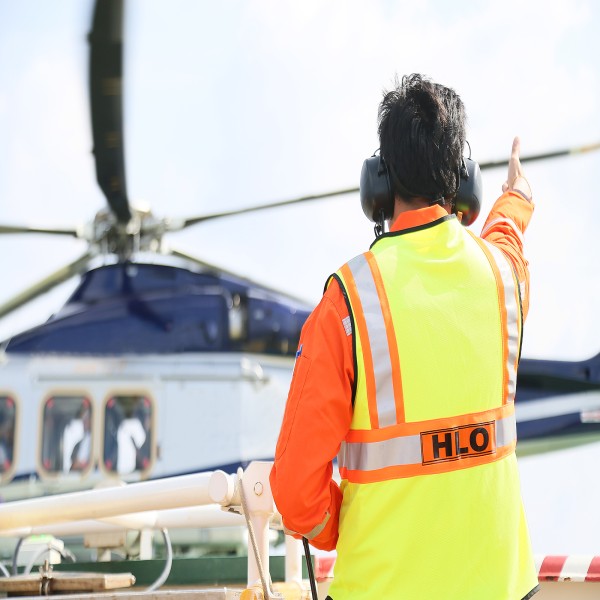
The Helicopter Landing Officer (HLO) Course is designed to train individuals in safely managing helicopter operations on offshore platforms, vessels, or helipads. HLOs play a crucial role in ensuring the safety and efficiency of helicopter landings and takeoffs in various environments, particularly in the oil and gas industry where helicopter transport is common.
The Offshore Helicopter Landing Officer (HLO) oversees the daily operations of the helideck, manages associated activities, and supervises Helideck Assistants (HDAs). Additionally, the HLO leads the initial response to helicopter emergencies on offshore fixed, mobile, or floating installations, while also supervising HDAs who serve as Helideck Emergency Response Team Members (HERTM) in their capacity as Helideck Emergency Response Team Leaders (HERTL). HDAs primarily handle routine helideck operations.
What will I learn?
- 1. Understand key regulations and guidelines for helideck operations, including helideck physical characteristics, obstacle-free requirements, and equipment/systems.
- 2. Recognize typical hazards associated with offshore helideck operations and apply safety protocols.
- 3. Comprehend meteorological requirements for offshore helicopter operations.
- 4. Define the role of the Helicopter Landing Officer (HLO) and explain key responsibilities and required actions, including: 30 minutes and 10 minutes before helicopter ETA, Immediately before landing., Post-landing duties: rotors running turnaround, engines shut down, and tie-down procedures, Fitting engine blanks and covers and managing helicopter start-up.
- 5. Interpret the structure and terminology of pre-flight weather reports and floating installation (or vessel) data required by the helicopter pilot.
- 6. Identify, package, and label dangerous goods according to IATA and ICAO regulations, including the
- 7. Understand specific HLO responsibilities for Normally Unattended Installations (NUIs).
- 8. Conduct radio checks, communicate effectively with relevant personnel, and use standard radio communication protocols, including HLO-to-pilot communications.
- Dangerous Goods Training: Completion of a Dangerous Goods by Air course (ICAO, IATA Categories 7, 8, or 9, or state-approved awareness course).
- Medical Fitness: Valid medical fitness certificate.
- Language Proficiency: Proficiency in the course language.
- Offshore Safety Awareness: Basic offshore safety awareness (recommended but not mandatory).
- 1. What is a Helicopter Landing Officer (HLO) course?
HLO training prepares you to manage offshore helicopter landing, departure and helideck operations safely, including communication, cargo handling and emergency procedures. - 2. Who can take the Helicopter Landing Officer (HLO) course?
The course is intended for personnel who are going to work as HLOs on offshore platforms, vessels, floating installations or other helideck facilities. - 3. What are the requirements for an HLO course?
A Dangerous Goods by Air course, valid medical fitness and proficiency in the course language are required; basic offshore safety awareness is recommended. - 4. How long is the HLO course?
The Elite Offshore HLO course has a 24-hour training duration and is conducted as offline training. - 5. What does an HLO do on an offshore helideck?
An HLO supervises helicopter arrivals and departures, checks the helideck, coordinates the helideck team and helps maintain safe helicopter operations. - 6. What topics are covered in HLO training?
Training covers helideck safety, helicopter hazards, weather information, landing and departure procedures, radio communication, cargo and dangerous-goods handling, and NUI operations. - 7. Does the HLO course include helicopter emergency procedures?
Yes. HLO training covers the HLO's responsibilities during helicopter and helideck emergencies and the initial emergency response arrangements. - 8. Is radio communication part of HLO training?
Yes. The course covers radio checks and standard communication procedures, including communication between the HLO and helicopter pilot. - 9. Is HLO training useful for offshore oil and gas jobs?
Yes. HLO training is specifically aimed at personnel appointed to helideck roles and is relevant to helicopter operations on offshore oil and gas installations. - 10. Does HLO training cover cargo and dangerous goods handling?
Yes. The course covers cargo preparation and the identification, packaging and labelling of dangerous goods in line with applicable IATA and ICAO requirements.
-
Prepare for helicopter landing
Preview .
-
Coordinate preparation of freight
Preview .
Write a public review