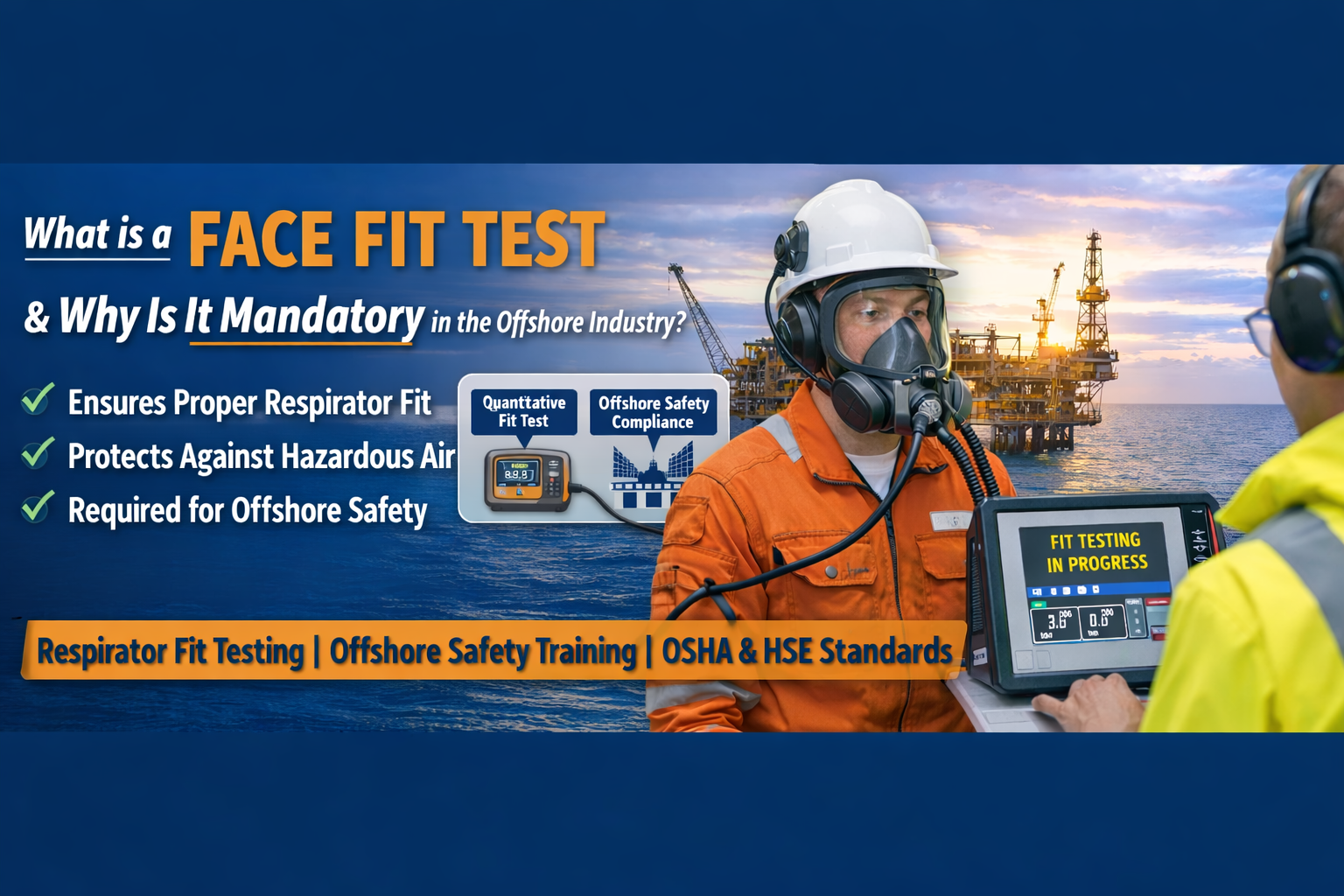
In the offshore oil & gas industry, workers are regularly exposed to hazardous substances such as gases, vapours, fumes, and airborne particles. Respiratory Protective Equipment (RPE) plays a critical role in protecting workers — but simply wearing a respirator is not enough.
If the mask does not fit properly, it cannot protect you.
This is where a Face Fit Test becomes essential.
What is a Face Fit Test?
A Face Fit Test is a procedure used to ensure that a tight-fitting respirator forms a proper seal on the wearer’s face.
Even small gaps between the mask and the face can allow hazardous air to leak inside. A fit test confirms that:
The selected respirator is suitable for the individual
The mask forms an effective seal
The worker is adequately protected
Without proper fit testing, respiratory protection becomes unreliable.
Why is Face Fit Testing Mandatory in Offshore Industry?
Offshore environments involve high-risk operations such as:
Handling chemicals
Gas processing
Sandblasting and painting
Emergency response situations
In such conditions, exposure to toxic substances can lead to:
Respiratory diseases
Lung damage
Long-term health complications
Fatal accidents in severe cases
International safety standards such as OSHA, HSE, and offshore safety guidelines require fit testing before a worker uses a tight-fitting respirator.
It is not optional — it is a compliance requirement.
When is a Face Fit Test Required?
A face fit test must be conducted:
✅ Before first-time use of a respirator
✅ When a different respirator model or size is issued
✅ After significant weight change
✅ After facial surgery or dental work
✅ If facial features change
✅ Periodically as per company policy
Facial hair can also prevent a proper seal. Workers must be clean-shaven where the mask seals against the face.
Types of Face Fit Tests
There are two main types:
1. Qualitative Fit Test (QLFT)
Based on taste or smell detection
Suitable for half-mask respirators
Simple but less precise
2. Quantitative Fit Test (QNFT)
Uses advanced equipment
Measures exact leakage levels
Provides numerical fit factor results
More accurate and reliable
For high-risk offshore operations, quantitative fit testing is strongly recommended.
Why Proper Equipment Matters
Accuracy in face fit testing depends on:
Calibration of equipment
Proper test protocols
Trained operators
Documentation and certification
To enhance our safety services, we have recently invested in a new advanced Face Fit Testing device to ensure:
Accurate quantitative results
Faster testing process
Reliable compliance documentation
Industry-standard certification
This allows us to provide high-quality respiratory protection testing aligned with offshore and industrial safety requirements.
Consequences of Skipping Face Fit Testing
Failure to conduct fit testing can result in:
Regulatory penalties
Non-compliance during audits
Increased accident risk
Compromised worker health
Legal liabilities
Most importantly, it puts lives at risk.
Safety is Not Just Wearing PPE — It’s Wearing It Correctly
Many workers believe that simply putting on a mask is enough. In reality, an improperly fitted respirator can reduce protection by more than 50%.
Face Fit Testing ensures that protection works when it is needed the most.
In offshore operations, where emergency situations can escalate quickly, there is no room for assumption.
Conclusion
A Face Fit Test is not just a procedural requirement — it is a critical safety measure that ensures respiratory protection functions effectively in hazardous offshore environments.
With increasing industry focus on compliance, competency, and worker safety, proper fit testing is now an essential part of offshore operations.
Investing in the right equipment and certified testing procedures is an investment in worker safety and regulatory compliance.
Explore our Face Fit Test service to ensure full compliance and worker protection.

Write a public review